Recently added

Mordents and turns are common embellishments for Lennon [...].
— Walter Everett, The Beatles as Musicians, Vol. 1 (2001), p. 72
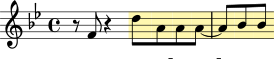
Many Beatles songs written by John Lennon contain mordents in the vocal melody: a note briefly ornamented by an adjacent scale degree before returning to the original note. He often places them near the ends of phrases where they're followed by a downward resolution to the tonic.
These ornaments are common in many styles of music, but they distinguish Lennon from his bandmates Paul McCartney and George Harrison, who use them much less often. Lennon himself uses them most in his R&B-inspired songs from the early '60s.
There are also conspicuous vocal mordents in "Do You Want To Know A Secret," which was sung by Harrison but written by Lennon.
References in later music
The Beach Boys
It was clear that the Beach Boys were listening to the Beatles in 1964; [...] [Brian] Wilson adopted Lennon's mordent in such songs as "Don't Worry Baby" and "You're So Good To Me."
— Walter Everett, The Beatles as Musicians, Vol. 1 (2001), p. 276


Points of connection
- These songs share a rhythmically and lyrically identical 4̂-3̂-2̂ melody in the key of A major
- Girl Almighty contains substantial material from another Paul Simon song (The Obvious Child)


These songs share
- The key of E minor
- Verse melodies that alternate 2̂ and 3̂ in a similar rhythmic pattern
- Lyrical reference to a gun, unusual in the work of Michelle Branch


Similarities
These songs share a repeating series of six intervals in similar metric positions, each ending on the word "want."

Many hip hop and R&B songs from the '90s and late '80s feature percussion swung at the 16th-note level. In this context, when a rapper articulates 16th-note triplets, it creates a distinctive sound commonly associated with Das EFX.
It fell out of popular use by the latter half of the decade.

Many pop-rock songs from the '90s and early '00s create a lingering unresolved feeling by including the 4th scale degree in their final chord.
Sometimes it's the root of a IV chord, but it can also be the 5th of the bVII chord.

Paul Simon achieves a folky quality in his melodies by descending stepwise from 2 to 1, then leaping up to 3 and descending stepwise to 1 again: 2-1-3-2-1.
Often, but not always, this pattern is preceded by an additional 3: altogether, 3-2-1-3-2-1.

[...] there is a certain vocal gesture used by singer-songwriter Ben Folds [...] that tends to occur at the ends of phrases (scale degree 5̂ falls to 3̂, and then leaps up to 6̂). It may seem like a coincidence, [...] but in Ben Folds Five’s cover of the Buggles’ classic "Video Killed The Radio Star" [...] Folds interpolates the 5̂-3̂-6̂ gesture at the end of a phrase that, in the original version, was simply a repeated dominant tone.
— Nathaniel Adam, Coding OK Computer (2011)


5̂-3̂-6̂ in original songs by Ben Folds


These songs share
- The first and third measure of their intro guitar riffs (shown)
- A lyrical theme and some similar phrases ("I got him where I want him now" vs "I had him right there where I wanted him")


These lines have identical lyrics, an identical rhythm, and share four of their seven pitches.


The choruses of these songs
- Start their first two measures on a high 5̂
- Share identical rhythmes for the first measure and a half
- End their first phrase with a high melisma on 3̂-6̂-5̂, sung on "whoa"
Taylor Swift and Hayley Williams sang That's What You Get together at a concert in September 2011.

In the late '90s and early '00s, pop songs often used the leading tone in a minor key (i.e., the note one half-step below the tonic), along with the V7/vi dominant chord to which it belongs.
Ancestors
There is [...] a tradition of pure [i.e., "harmonic"] minor modality, blues aside, in the R&B music of Stevie Wonder and Michael Jackson; this is the heritage of the Backstreet Boys.
— Walter Everett, "Pitch Down the Middle", from Expression in Pop-Rock Music (2008), p. 172
References in later music
Meghan Trainor
Time Magazine: Were there any artists you were thinking about as reference points while creating [the 2016 song No]?
Meghan Trainor: Obviously we wanted that '90s feel that everybody loves and recognizes and misses.
— Time Magazine, 2016
Eminem
Despite Eminem's outspoken disdain for the boy bands of the '90s, many of his early songs inherited the harmonic minor scale from those very bands.
An anti-Backstreet and Ricky Martin
Whose instinct's to kill *NSYNC, don't get me started
Those fuckin' brats can't sing, and Britney's garbage
— Eminem, Marshall Mathers (2000)

2Pac often inserts a pair of 32nd notes into a line otherwise comprised mostly of 8th and 16th notes.
He did it on his earliest recorded verses as a member of Digital Underground and continued throughout his career.
Several other artists in the early '90s, including Digital Underground, used sixteenth-note triplets over swung beats to create a similar effect, but 2Pac is unusual in doing it consistently over straight percussion.
References in later music
Eminem
Eminem's rhythms sometimes contain a pair of 32nd notes, often to fit an unrhymed syllable into a multisyllabic rhyme scheme. In 2003's Soldier, the accompanying lyric suggests an intentional stylistic reference to 2Pac.

It was common in the 1970s and '80s to end a rap line with this rhythmic figure on the third beat of a measure:
It fell out of favor by the early '90s.
References in later music
The Pharcyde
The Pharcyde's 1992 song Return of the B-Boy, which opens with the lyric "yo, is '87 in the house," uses this rhythm to imitate the sound of the '80s.

Several Billy Joel songs from the mid-'70s contain a similar rhythmic pattern: he sings a dense sequence of sixteenth or eighth notes, with a note onset on all subdivisions but the first in each group of four.

Bob Dylan adds a tender, vulnerable quality to many of his phrases by ending on 4 over a I chord with which it does not agree; this [...] is so frequently heard [...] that it might be referred to as the Dylan cadence.
— Walter Everett, The Foundations of Rock (2009), p. 186

In the early '90s, Ghostface favored a sequence of three rhythms, always appearing together in the same bar:
- 2-3 syncopated eighth notes
- the last three sixteenth notes of the third beat
- a single-syllable rhyme on the fourth beat

Little Richard made famous the registral isolation of a single tone in falsetto [...]. Richard would usually break his voice to arrive on a high 1̂ [...].
— Walter Everett, The Beatles as Musicians (2001), p. 73
References in later music
Paul McCartney
[Little Richard] would say, 'I taught Paul everything he knows'. [...] I had to admit he was right.
— Paul McCartney, Twitter (2020)

Swift has her own melodic signature [...]: a three-note melodic motif [usually descending from 4̂ to 3̂ and then to 6̂] that we've termed the "T Drop."
— Nate Sloan & Charlie Harding, Switched On Pop (2020), p. 22
It first appears in You Belong With Me (2008) and is a consistent feature of her writing since then.


The sequence [that opens the chorus of Movin' Out] is heard untransposed [...] in the F-major Sonatina ascribed by Thayer to Beethoven's Bonn period (first movement, mm. 35-38).
— Walter Everett, 2000. "The Learned vs. The Vernacular in the Songs of Billy Joel". Contemporary Music Review, 18(4).


I was really inspired by that synth riff in that song “Betty Davis Eyes.”
— Caroline Polachek, interview with genius.com, 2020
The verses in both songs alternate one-bar phrases between two voices, emphasizing the second eighth note in each measure.


In 2017 on Instagram Live, John Mayer described the guitar riff from Edge of Desire as "not that different from Satellite
In 2025 on his Sirius XM radio station, he also recounted that as a teenager he'd practiced using a four-track recorder by recording layered guitar parts from Satellite.


These songs share
- A section comprised of three notes, one per measure, with two voices in harmony, where one voice descends from 3̂ to 2̂ to 1̂
- A snare drum pattern that accents the second eighth note of the third beat in each measure
- The long "A" vowel on the first syllable


These songs share
- Phonetically similar words ("had"/"have", "money"/"mighty", "son"/"young") occur in the same rhythmic locations (underlined)
- Two measures of unaccompanied lyrics alternate with two measures of rhythmically and harmonically similar guitar chord stabs
- The highlighted sections of melody are identical


These songs share
- A lyric
- A sequence on the word "waterfalls" that descends from 7̂ to 6̂ and then to 5̂ (though the 7̂ is flat in McCartney's case)
AV Club: TLC ripped off Paul McCartney? I had no idea!
Paul McCartney: I think so.
— AV Club interview (2007)


Similarities
They share a three-note sequence, each located at the end of its phrase: 2̂ rises to 3̂, then drops to 5̂.
SZA performed Kiss Me in concert six times in 2019.